and this hallowed Courthouse may laugh last.
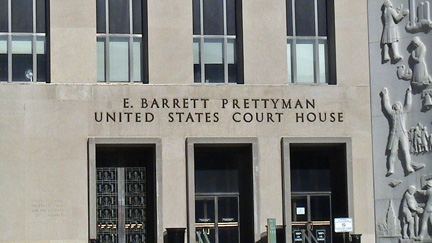
In our nation's capital, students of history (yours truly included) with a little digging can uncover little known facts, information and sometimes irony, even as it unfolds right under our very noses. Take for example, the E. Barrett Prettyman United States Courthouse where the Libby trial began this week.
It may surprise you to know that the District of Columbia Circuit is composed of three courts: the United States Court of Appeals for the District of Columbia Circuit, the United States District Court for the District of Columbia, and the United States Bankruptcy Court for the District of Columbia. While most federal circuits encompass courts located in several different states, the District of Columbia Circuit is unique in that all Courts of the Circuit are centrally located in one building. Lot's of Justice being served here.
Construction of the original Courthouse was completed in 1952. In 1997, the Courthouse was renamed and dedicated in honor of a great champion of law E. Barrett Prettyman, who was appointed to the Court of Appeals in 1945, and served as Chief Judge from 1958-1960.
On April 8th, 2002 hallowed ground was ceremoniously broken to begin a remodeling and expansion project making the building and adjoining annex what it is today. Like Judge Prettyman, this Courthouse is very special indeed, particularly the monument in front. Excerpts and scenes from the Declaration of Independence, the Constitution and the Fifth Amendment grace one side of the triangular 24-foot-high shaft of granite with scenes depicting portions of the Bill of Rights on the others. Sensitive to individual rights, the right to privacy and the rule of law this monument was Judge Prettyman's idea.
A few years ago, someone else had another bright idea (probably a press secretary) to have their boss, an elected official, make an important address here (probably every word written by a speechwriter) at the groundbreaking ceremony for the new construction.
Ironically, recent events are proving this official's actions to be incongruent (some say antagonistic) with the spirit and laws of our nation's founding documents. Whether or not he fully appreciates or comprehends their true meaning, or is just exhibiting a total lack of regard for them, is unclear.
In the long term, history will be the judge. In the short term, it may be twelve of his peers in this very Courthouse where his former Chief of Staff, I. Lewis "Scooter" Libby is on trial.
THE VICE PRESIDENT: Well, thank you very much, Mr. Chief Justice; Chief Judges Ginsburg and Hogan; judges of the district and circuit courts; Delegate Norton; ladies and gentlemen. I'm delighted to join all of you here today for today's ceremony.
Usually, when a crowd gathers outside this building, somebody is in trouble. (Laughter.) Today is a happy exception: we're here to break ground on an annex to this fine, old structure. The U.S. Courts Building does not really stand out in the Washington landscape. It's not known for special style or flare or extravagance; nothing at all flashy about it. In short, the perfect place for a joint appearance by Dick Cheney and Bill Rehnquist. (Laughter.)
The E. Barrett Prettyman Courthouse is named for one of many distinguished jurists to pass through here in a half-century. Others, of course, included David Bazelon, Burnita Matthews, Warren Burger, Robert Bork; current Justices Antonin Scalia, Clarence Thomas and Ruth Bader Ginsburg. Those names represent varying judicial philosophies. Together, they reflect a single standard of excellence and integrity that is maintained to this day.
Here and in courthouses across America, federal judges go about the hard and serious work of delivering justice. I'm sure many of you will attest that the rewards do not come in wealth, for even the most experienced judge, the job requires daily discipline, sustained concentration, a searching mind and alert conscience.
Judges are given a great deal of authority and, with it, a great deal of responsibility. The highest rewards come in discharging that responsibility with honor, impartiality and humanity. You do that job well and you have the nation's gratitude.
The federal courts of the District of Columbia are among the most important in the land. And the trials and appeals conducted here are among the nation's most high-profile cases. By statute, appeals for many Agency decisions are taken directly to the courthouse. And under a law signed by President Bush after the attacks of last September 11th, the D.C. Circuit will be the exclusive venue for appeals in certain matters involving alleged terrorists.
The addition of new work space here reminds us of the increasing demands on our federal judiciary and the enormous importance of its work to the nation. President Truman at this site in 1950, as the cornerstone was laid, said that afternoon, "One of the most important duties of the President of the United States is to appoint federal judges. I give that more thought, more care and more deliberation than most any other thing I do in my duties."
President Bush views his responsibilities the same way. Judicial nominees must be men and women of experience, meeting the highest standards of legal training, temperament and judgment. They must respect the powers given them under the Constitution and the limits of those powers. And they should be lawyers of skill, discernment and high character.
Just under a year ago, the President announced his first nominees for the federal bench. Yet, of these 11 men and women, only three have been granted a hearing in the United States Senate. All of the others are still awaiting confirmation hearings, including two superbly qualified nominees to the D.C. Circuit, John Roberts and Miguel Estrada.
As we begin the work of expanding this building, it's worth remembering that a courthouse is not a court. Only judges make a court, and one-third of the seats on this circuit court are empty today. For another court of appeals, the 6th Circuit, covering Ohio, Michigan, Kentucky and Tennessee, seven Presidential nominees still await hearings. That court sits half empty, with eight active judges doing the work of 16.
Nationwide, nearly a hundred district and circuit judgeships are unfilled, and 40 of them have been classified as judicial emergencies. The President is committed to filling them and has submitted to the Senate the names of 98 nominees. Yet, there are today more judicial vacancies than on the day we were inaugurated. The pace of attrition is actually faster than the pace of the Senate confirmation process.
The Senate's delays are causing a vacancy crisis and they are inexcusable, endangering the quality of justice in the federal courts. As a matter of respect for the judicial branch, and courtesy to the executive branch, and simple fairness to the nominees themselves, the Senate should do its duty and give a prompt hearing and vote to every person selected for this and other courts.
Perhaps this construction project, within sight of the Capitol, will stir the Senate and cause new judges to arrive here. As a friend of mine said, "Maybe if you build it, they will come." (Laughter.)
Every judge here today holds his or her post because that simple consideration was given to them. They have reflected credit on the President's of both parties who selected them, on the senators of both parties who confirmed them. This morning I want to thank one, in particular, Judge Harry Edwards, for his diligent efforts as Chief Judge in getting the building annex underway.
In the years and the decades to come, all who work here will follow in the finest traditions. I am certain that the best legal talent America can produce will be collected here for as long as these buildings stand.
Thank you very much. (Applause.)
END
Who's laughing now, Mr. Vice President? Maybe E. Barrett Prettyman, maybe our founding fathers, maybe me. (Laughter and Applause.)
This post is dedicated to Jane at Firedoglake and offered as lite reading and best wishes for her speedy recovery.
Labels: Prettyman Courthouse, Public Service